
Part 1 named system thinking as the work. Part 2 described the harness around it. Part 3 showed what the org built on it actually looks like. This is the personal piece — what to invest in inside it.
When I shared on how AI-native orgs look like in part 3 — the way the work is reshaping, why this moment isn’t really about switching chairs between IC and manager. A friend of mine cracked back:
“Many of you want to become Director or VP. Well — now you’ve got hundreds of AI agents to manage.”
A joke — with enough truth in it to reveal the reality: everyone is now expected to show up at their N+ level. At the AI-native edge, the top companies have moved the hiring bar — job descriptions now call for "a proven track record of stepping into 0 to 1 environments." Pedigree weighs less than evidence now.
Most career advice for this moment still tells you to ship more, run sharper alignment meetings, manage up harder, introduce better processes. AI is folding all of them. Investing more there is investing in the past.
So — how do you prepare?
What follows is a way to think about it. A framework for where to put your finite time and attention. The rubric goes stale fast because your management is playing the same catch-up you are.
Three altitudes — how you see the work, how you see your time, how you see yourself. None of these are in the rubric. Some are unwritten rules— what calibration rooms quietly value without naming. The AI era is just weighting them more heavily, and pulling them down to apply at every level.
How you see the work
The first shift is from seeing yourself as an executor of pieces to seeing yourself as a problem framer.
Most of us were trained to wait for the problem to arrive defined, then execute. Your leader figures out what to do; you make it happen. That made sense when coordination was expensive and decisions were scarce. AI made coordination cheap. The easy decisions got cheap too. What’s harder now isn’t shipping the work — it’s framing the problem in the first place. Mapping where the bottleneck actually lives. Deciding what to build that the system can absorb.
When I was a manager venting to a mentor about a product I was frustrated with — the team was capable, but the strategy upstream felt off — her answer wasn’t to influence the product team. It was to fix the product myself. She looked at me and said: stop seeing this as your product team’s problem to solve. See it as if you were the CEO of this product. True ownership isn’t doing the execution. It’s seeing potential, finding creative ways to push forward, and absorbing the failed bets as sharpening for the next. That single shift was what built the cross-functional muscle I drew on for director and beyond.
A staff engineer I worked with at Instacart was already operating this way. We’d been hypothesizing AI-enabled marketing infrastructure to power our growth experiments — obvious now; less obvious a year or two ago. The pushback hadn’t been about vision; people believed in the bet. They worried about the distraction cost — pulling attention from work that already had committed business impact. So instead of pushing for headcount, he spent his weekends hacking out a prototype and testing it with the internal marketing team on limited channels. A few months later, leadership realized we needed this infra — and was pleasantly surprised to find it already in place. The infra he’d built accelerated the bet, and product set the priority.
When you see the work this way, end-to-end ownership stops being a stretch — it’s the natural shape of how you operate. So does pruning processes that no longer serve, and staying close to the customer to hear what the system isn’t telling you. They’re consequences of the framing.
At junior level, this kind of move sometimes gets feedback like stepped on other people’s toes. At senior levels it’s an explicit expectation. How you see the work decides how you show up.
How you see your time
Are you still going by agenda?
Most people in tech are. They let other people’s calendars decide where their hours go. Coordination meetings, alignment syncs, one-off requests, status updates. When you tally up where the day went, most of it went there.
The discipline is treating your time as precious. Sort what’s coordination, what’s one-off, what’s actually building the system underneath your work. The system underneath is what compounds. The other two don’t.
A senior staff leader I worked with operated at the edge of this. He was quiet in bullshit meetings — didn’t perform engagement, didn’t fill silence. He wasn’t very responsive on Slack either. From the outside, easy to misread as disengaged. From the inside, he was spending his real time identifying levers and opportunities. He’d invested in relationship-building with his manager peers and kept his resource asks small. When the moment came, the tiger team formed fast. Significant business impact landed. After it did, he gave credit to the leads who’d sponsored him on resourcing. They moved on to form bigger partnerships.
His promotion discussion was controversial. People who valued coordination and alignment didn’t like him. People who admired entrepreneurship loved him — they could see the enormous value he was going to generate for the business. We ended up making an exception — we wanted to encourage more engineers like him.
The conventional path to promotion rewards broad visibility — being in every meeting, replying fast on Slack, performing engagement. He didn’t reject visibility. He picked where to invest it: targeted trust with the manager peers who’d matter for resourcing, plus the system thinking that produced the impact. The hours he saved from broad engagement bought the time for both. They were the same skill.
Naval Ravikant has reshaped how I think about my time. “Set an aspirational hourly rate” — put a floor on your hours, refuse what doesn’t clear it. “Work like a lion, not a cow.” Most corporate life isn’t even cow-like; it’s a hamster wheel — constantly running, never resting. The hours below the rate are what AI is making cheaper. The hours like a lion are where everything compounds.
How you see yourself
Last comes how you see yourself — who you’re choosing to become in the work.
The conventional path tells you who to be — the role, the next step, what success looks like. It works until you notice you’ve been optimizing for someone else’s definition of you for ten years.
The question AI is making harder to avoid: what would I want to be building inside myself, if no one was measuring? The bets you make and risks you absorb don’t just shape your career. They shape who you become while doing the work.
A pattern keeps surfacing in the women-in-tech communities I was part of. When senior leads look back, the regret that comes up most often isn’t I should have networked harder or I should have been louder. It’s I didn’t take enough risk. Deeper: I let the rubric write my story when I could have been writing it myself.
A few years back, a tech lead I worked with had a promotion path lined up on her team. She walked away to move into machine learning — out of curiosity, not fear of falling behind. The move took courage and potential reset. The transition took real effort. What she didn’t predict: it made her more competent on the job market than the safer-track version of her would have been. The bet on her curiosity paid the most.
Don’t limit your curiosity by your role, title, level, function, or company. AI-native work runs on problem-framing, and curiosity is what helps you see problems worth framing. Walk outside your company. Network. Exchange ideas with people doing different work. You’ll notice you’re not alone. The rubric inside one company looks smaller when you can see the work happening across many.
I know this pattern well. I played the safe card for years myself, afraid of failing — optimized for higher pay and a better title. But I started to ask myself this question in recent years: who am I without the title? This year, AI is forcing many people into the same question.
All we can bring with us is the experience. The titles change shape. The companies change. What stays is what you built inside yourself — and who you became while you were building it.
What folds, what overlaps, what’s fresh
Some tactical examples to guide your framework. The skills above sort into three buckets.
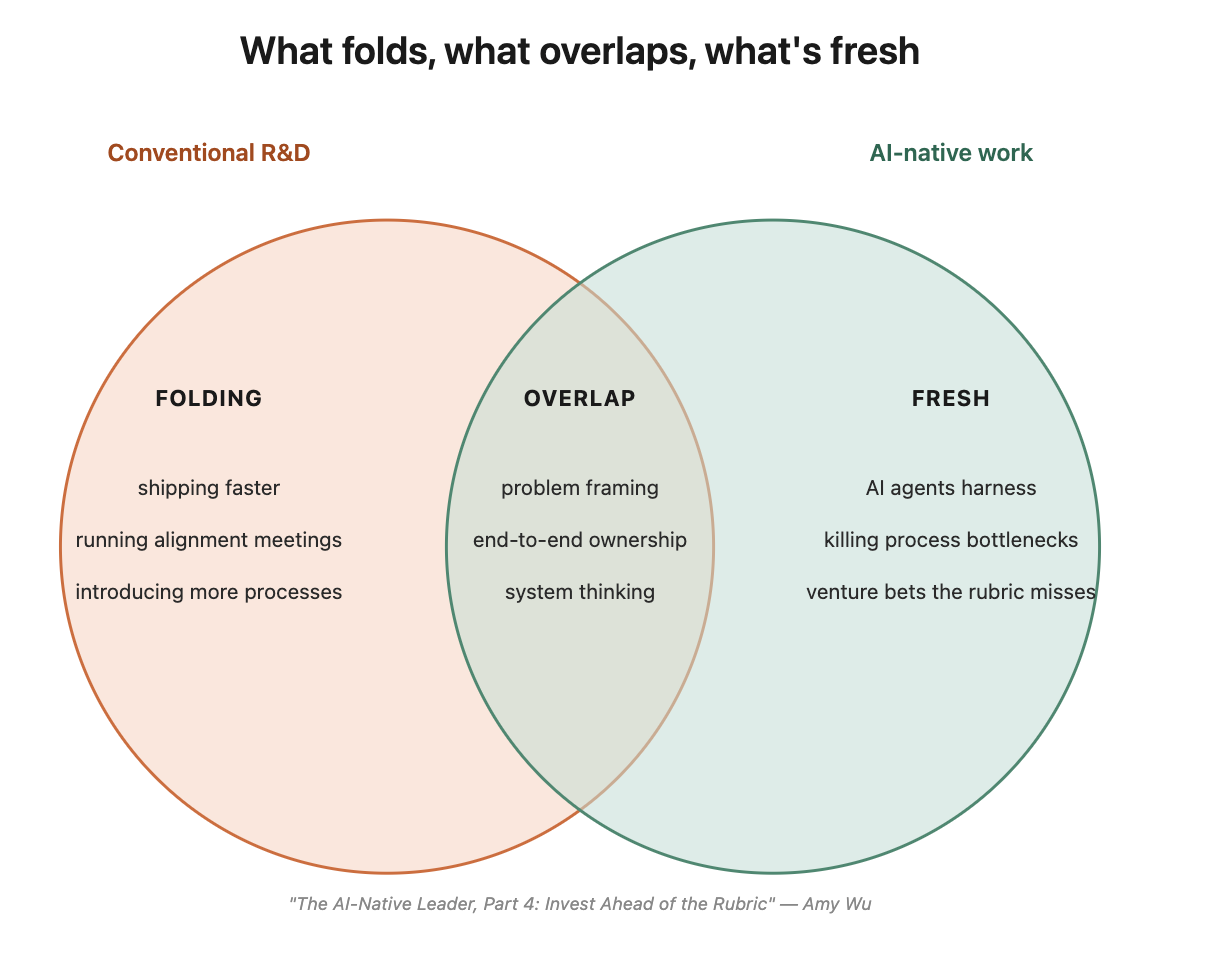
The ones AI is folding — shipping faster, running alignment meetings, managing up, introducing more processes — are what conventional R&D has rewarded most at junior levels. Investing more there is investing in the past.
The ones that overlap with what senior leaders have always done well — problem framing, end-to-end ownership, system thinking — have always compounded. The AI era is amplifying them and asking you for them earlier than the rubric measures.
The ones that are new skills to pickup — managing your AI agents like a team, killing meetings and processes that create bottlenecks, taking the venture bets the rubric can’t measure yet — are where the AI-native edge differentiates. Even senior leaders historically didn’t have to invest much here. The era is changing the bar.
Where to put your energy
The energy you’ve been spending — on whether you’ll get promoted next quarter, whether the layoffs will reach you, whether your manager is happy with you, whether you should work harder just to keep the job — that’s fear-driven. It’s what the rubric trains you to care about. It’s not what compounds.
The shift isn’t from fear to love overnight. The fears are real — the rubric still partly governs your runway. But when you notice the rubric is outdated for the work that’s actually coming, you can start to release some of the fear pinned to it. Try using that released energy to pick up something that gives you energy back.
You don’t have to take it all on at once. Build slowly.
The next time you’re choosing between the safe project and the unclear one, notice what you’re optimizing for. The rubric — or the work that’s already coming. One you can’t take with you. The other becomes who you are.
That’s the four-part series. Part 1 on system thinking. Part 2 on the harness. Part 3 on what the org looks like. And this one — what to invest in inside it.
About Amy Wu
I’m an executive and life coach who works with leaders navigating inflection points — including the one AI is creating right now. If you’re sorting through what to invest in for what comes next, I’d love to hear what you’re seeing.