
“Should I move to management — so I can build influence and get invited into the decision-making room?”
A version of this comes up in almost every coaching conversation I have. My answer is the same one I’ve given for years. Find out how your managers actually spend their time, and whether the title is still where influence sits in your company. That depends on stage, on culture, and now on how AI-native the org is.
AI isn’t just speeding up work. It’s reshaping what each role does. The better question is: what does the work look like inside an AI-native org?
In Part 1, I argued the AI era needs leaders who think in systems, not workflows. In Part 2, I described what that system looks like — two harnesses, one around the agents, one around the people. This piece is about what those harnesses actually do, day to day.
Two patterns of work
Inside the harness from Part 2, the work in an AI-native org sorts into two patterns. Both run at once, in different ratios depending on stage and bet.
Pattern one: iterative work on a real, running business. Existing product. Existing customers. Continuous experiments — pricing, onboarding, retention, feature shipping. The bulk of execution.
Pattern two: frontier work. New business line. Big pivot. A hypothesis nobody’s run yet. The bets that decide whether the company gets a second chapter.
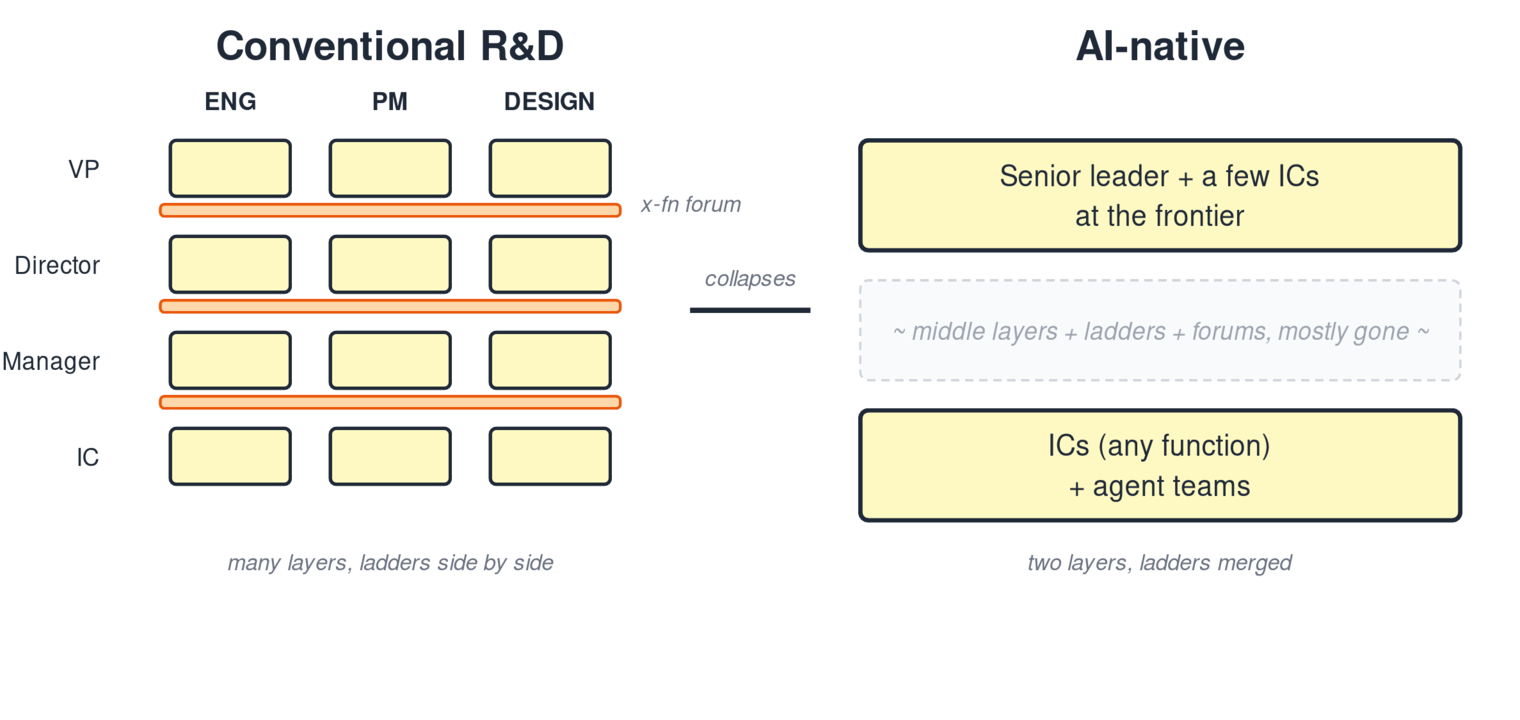
A conventional R&D org has many function ladders, each many layers deep, connected by cross-functional review forums between layers. The AI-native version collapses all of it — the ladders merge, the middle layers go, the x-functional forums mostly go too.
In an AI-native org, influence and the decision-making room aren’t gated by a management title — they go to whoever’s running the harness well, owning a problem end to end, or pushing into the frontier. Regardless of Title.
The two harnesses operate differently in each pattern. I’ll take them in turn.
Pattern 1: Iterative work — one person plus an agent team
The shift inside iterative work is simple to name and hard to internalize.
One person, paired with an agent team, drives a piece of work end-to-end. Not “designer hands off to engineer hands off to QA hands off to PM.” One person owns the whole loop — frame the experiment, ship it, measure it, decide what to do next.
Which means everyone, regardless of role, ends up spending more time deciding what to do than doing it. The doing is harnessing the agents. The deciding is what fills the day.
This is where the two harnesses earn their weight.
The agent system harness — mostly IC work
Inside iterative work, the way you use your agents is the load-bearing variable. The difference between an IC who gets ten times more output and an IC who gets the same output as before is almost never which model they’re using. It’s how they’re feeding the model context.
In an AI-native org, every IC ends up managing a small agent team — whether or not the title says so. The quality of what comes back depends on how much of the relevant context you’ve actually gathered before asking, how you’ve structured that context — what’s signal, what’s noise — and how you supervise the output. What you re-prompt. What you accept. What you correct.
What the IC is doing here is management. Delegation. Defining scope. Setting up the system. Reviewing output and giving feedback. Deciding what gets shipped, what gets revised, what gets thrown away. These were always management skills. They’re now essential for anyone working with agents — title or no title. Some of the most effective people I see in AI-native orgs have an IC title and a manager’s day.
This is craft, and it doesn’t transfer instantly from old habits. The ICs running this well are still in their first year of it — learning to manage agents the way they once learned to manage their own attention. The orgs whose ICs are doing this are starting to run circles around orgs whose ICs are still treating LLMs as autocomplete.
The people system harness — mostly leader work
The leader’s harness inside iterative work is the layer above. Two design choices show up over and over.
The first is bottleneck management. Inside an existing org, you already have processes — experiment review, design review, layers of approval. Those processes were built for human throughput. When agents start producing five times more drafts, those review layers tend to become the bottleneck almost immediately. The work doesn’t get faster. It piles up at the choke point. Your job as a leader is not to set a speed goal and walk away. It’s to watch where the system is starting to clog and redesign that layer before it locks.
The second is end-to-end ownership. Let one person own a problem all the way through, regardless of role. If it’s too big, break it into smaller problems — but don’t break it across two people. Two people on the same problem reintroduces the coordination tax that the agent harness was supposed to release.
These are leader moves. They don’t happen on their own.
Pattern 2: Frontier work — go to the edge
Frontier work doesn’t run on the same harness. It can’t. The whole point is that there isn’t a known pattern yet.
Frontier work has a different shape. People go to the frontier — talk to potential customers, talk to people doing the research, read what’s being published, pull on threads. Frame the problem one way, watch it not work, reframe it. Bring what they’ve learned back to the team. Decide together what to try, what to drop, what to investigate further.
It also doesn’t specialize by role. At the frontier, the questions are too unstructured for “I’ll do design and you do engineering.” Whoever’s nearest the question goes. Whoever has the relevant signal pieces it together.
I’ve been living this myself in the last few months. Outside my coaching practice, I’ve been working inside a startup, where I’ve ended up picking up basic sales, marketing, product, design — none of which were my background — through agents that close the gap. I’m not great at any of it yet. But “great” isn’t the bar at the frontier. The bar is: can the team learn fast enough to know whether this is worth doing? The answer comes from people willing to own a question end to end, not from people defending their lane.
So in an AI-native org, frontier work pulls generalists. Iteration leans on the harness. Both happen at once — and for ICs, this means frontier work is more accessible, not less. The path doesn’t run through a management title anymore. It runs through being the person who’s already pushing toward the question.
What this asks of leaders
If you’re leading inside this kind of org, your job is not to set a speed goal and watch the dashboards. The dashboards will go up. They won’t tell you where the system is breaking.
Two things change.
Get your hands dirty inside the iterative pattern. Don’t manage the harness from above. Pick one experiment your team thinks is worth running and drive it end-to-end yourself. Frame the question, work the agents, sit with the output, push it through whatever review process exists. Within a week you’ll know exactly where the system grinds: which review layer is performative, where context is lost between steps, which handoff doesn’t need to exist. You can’t see this from above; you find it by doing one full lap.
And spend more time at the frontier. The people harness keeps the iterative pattern functioning, but it isn’t the deepest part of the leader’s job. As iteration gets more efficient, the bigger question becomes what new bets the company should be making — the new product line, the pivot, the experiment nobody’s run. That work doesn’t delegate cleanly, and it doesn’t get done if leaders are consumed inside the harness, managing the thing that already exists.
So when someone asks whether to switch into management, or back to IC, my answer is the same now: it’s not about the chair. The room moved, and the work changed shape underneath it. Prepare for the work the new shape is asking for — and which seat you’re in stops being the question.
About Amy Wu
I’m an executive and life coach who works with leaders navigating inflection points — including the one AI is creating right now. If you’re inside an org going through this shift and want a thought partner, I’d love to hear from you.