
AI caught management off guard this year. Layers were flattened, a lot of managers were moved back into individual contributor (IC) roles, and for a while it seemed the role itself would disappear soon.
The conversation has shifted since then. AI is changing what individuals and teams can accomplish, but the need for leadership hasn’t gone away. If anything, it’s raising new questions about what managers are actually needed for.
And still, the question keeps finding me: What did you learn from your years on the management track? Behind that curiosity, I suspect, is a more personal question: Should I pursue management?
I’ve answered it many times, and I’ve never been satisfied with my answers. I’d say management made me a better person, more empathetic and more humble. I’d say it helped me build a stronger business sense. Both are true. Neither is much use to someone standing at the decision.
So I thought it through carefully, and decided to write it down.
What senior ICs already do
Much of what people hope to gain from management doesn’t require the title.
Influence without authority. Earning the cooperation of other teams. Helping a group choose the problem worth solving. Strong senior ICs practice all of this every day. If that’s what draws you to management, you can cultivate it exactly where you are.
What management forced me to learn was something else.
The bet
A senior IC can own an ambitious project, sometimes one that spans teams and organizations. They can influence which problems an organization takes on and how it approaches them. A manager is accountable for the team’s entire portfolio of work, including what gets prioritized, what doesn’t, and whether the people available can deliver it.
The distinction sounds modest. It sits beneath much of the tension I’ve seen between senior ICs and managers, because the two are accountable for different things. An IC can advocate for a bet. A manager has to commit the team’s capacity to it, and answer for the outcome.
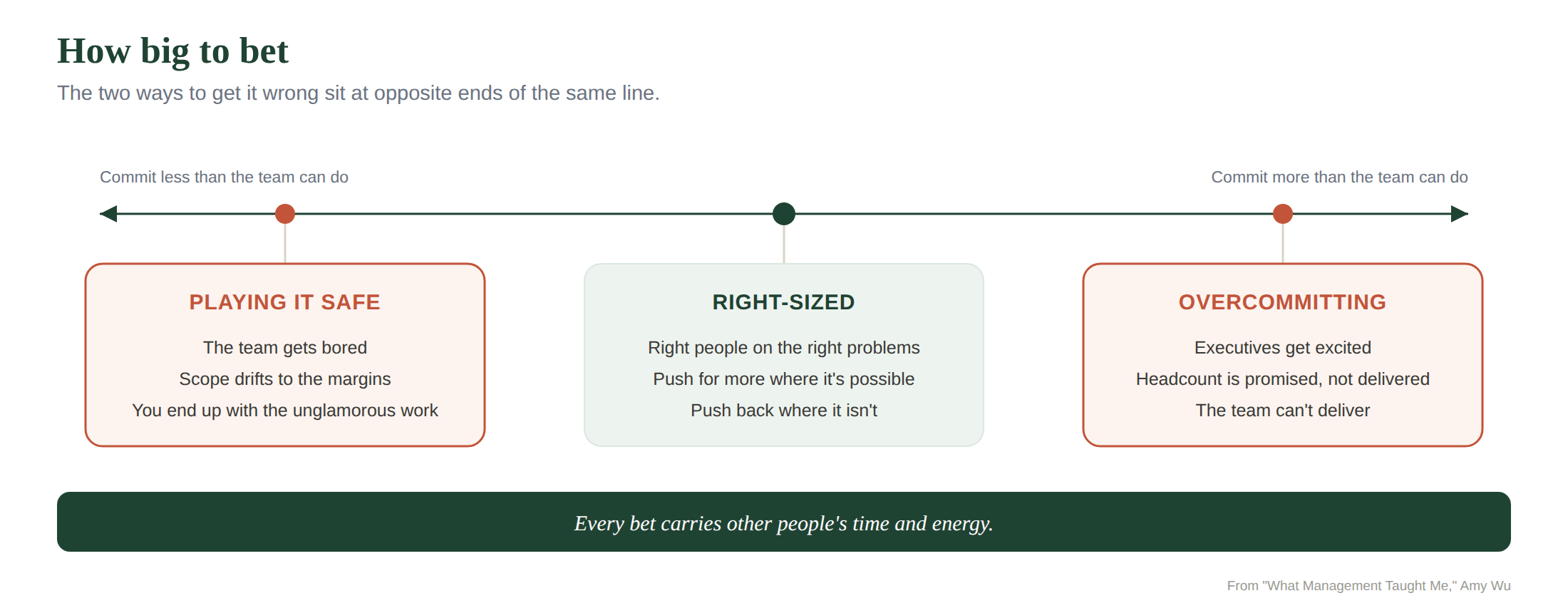
That is the source of the one thing I still draw on every day: a sense of how big to bet. The vision gives you a direction, but getting there is rarely a straight line. You have to judge how much risk is worth taking, which problems deserve your strongest people, when to push for more, and when to say that what you’re being asked to deliver isn’t possible. The ambition can stay the same while the path changes.
And you’re making those calls with other people’s time and energy, as well as your own. That judgment can fail in either direction.
Overcommitting
My first real lesson as a manager came from a critical initiative I should have pushed back on.
There was a gap between me and my VP while a director was being hired. The initiative was very risky, my team was too junior, but I committed to it without second guess. I assumed that if the VP was giving it to me, the support would follow. It never did, and I got the feedback about failing to flag the risk early on before committing. That failure almost sent me back to being an IC.
Looking back, I read it as a top-down push, something to execute rather than question. I didn’t realize I could negotiate it with my VP and flag the risks early, and that doing both was part of my responsibility.
You could argue my setup was the problem, with no director there to steer me clear. But this is a familiar pattern on the management track, and I’ve watched many failures start in one of two ways.
Sometimes the pressure comes from above. The levels above you will almost always push for more. Pushing back well is one of the trickiest parts of the job, and a manager who hasn’t mastered it yet can end up overcommitting without realizing it.
Other times, the manager sets the trap themselves. They paint an exciting vision, set an aggressive goal, win stakeholders over, and walk away with a generous headcount commitment. Hiring is uncertain, and in the end the team can’t deliver what was promised.
It isn’t a novice’s mistake. Everything is a moving target, and the larger your scope, the more noise seeps into your judgment. You have to be ready to change course at any moment. It’s no exaggeration to say you’re on a battlefield every day.
And when you get the bet wrong, it’s rarely you alone who pays for it. The team does, too. Their hard work doesn’t pay off, the promotions it was supposed to earn don’t land, and morale takes the hit.
Playing it safe
The opposite failure is quieter, and no less costly.
You commit only to what you’re certain you can deliver. For a while it reads as discipline. Then the team grows restless. Your scope drifts to the margins, and your group gradually becomes the one that absorbs the unglamorous work.
An IC can build a fulfilling career by becoming exceptionally good at their craft, without constantly seeking a bigger scope. But a manager who lacks ambition is making that choice for an entire team. Their people lose opportunities to stretch, grow, and take on work that matters.
This is why I believe a manager without ambition rarely lasts. I wouldn’t advise anyone to work for one, either.
Incubate, then graduate
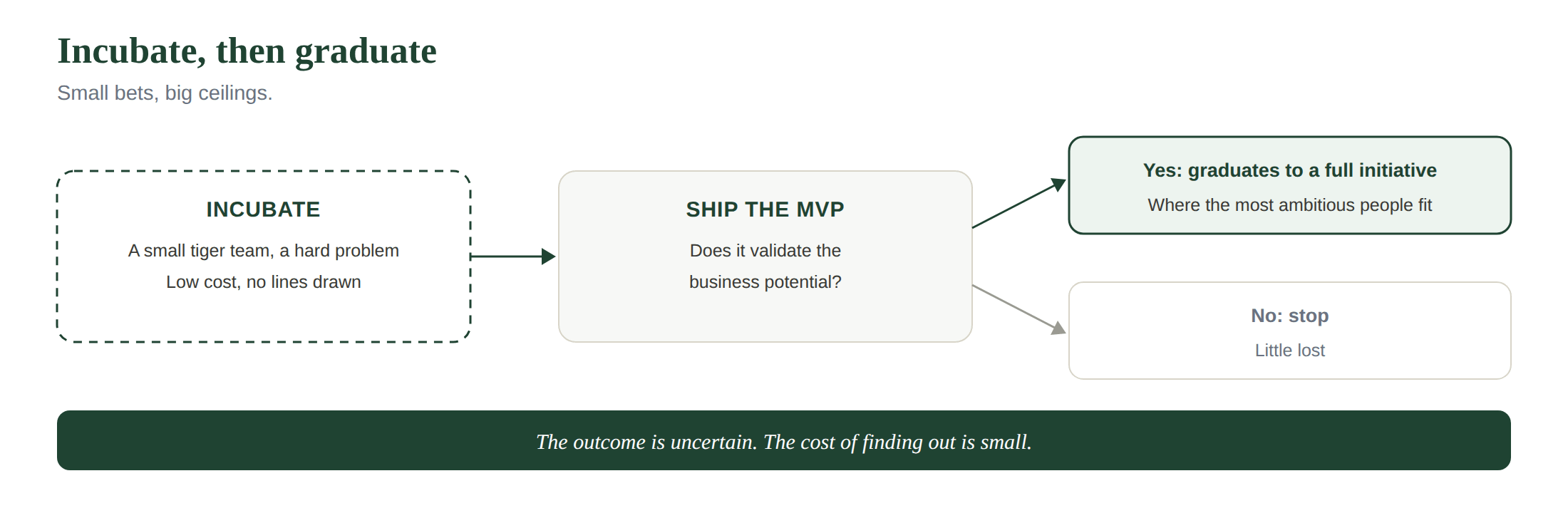
Given those two traps, is there a middle ground? What worked for me was a combination: don’t overcommit on the core work, and set aside room for one small bet with a big ceiling.
For problems that could change the trajectory of the business, I’d assemble a small tiger team around a vision that was ambitious and far from certain. I gave them the direction, not the path, and stayed close enough to challenge assumptions and call out risks along the way. Some of those bets paid off many times over. Others went nowhere. I’ve seen both, and they were the most exhilarating part of my management career.
Over the years, this became my own secret sauce. I think of it as an incubator. Because the team is small, the initial investment is limited. If the MVP ships and validates the business potential, it graduates into a full initiative, and that expansion is where the most ambitious, aggressive people on the team fit best. If it doesn’t, you’ve learned something without betting the entire team on it.
What I came to appreciate is that a big vision doesn’t always require a big commitment upfront. Sometimes the most meaningful progress comes from a small experiment that earns you the confidence to take the next step. You learn to be patient with the path without lowering your ambition for the destination.
All of this is easy to say and hard to do in practice. Your strongest people are usually claimed by work that’s complex, predictable in its impact, and tied to near-term results. So you stretch yourself across both, and you look for people who share the ambition and welcome the stretch. You won’t always have them.
AI is changing how much individuals and teams can accomplish, but it hasn’t made these bets easier to size. I often hear ICs complain that managers overestimate what AI can deliver, especially in complex legacy systems. The higher you go in management, the bigger the bets you’re expected to make, yet the further you are from the work needed to judge what’s realistic.
AI may change who makes the bets and how much they can accomplish. It doesn’t eliminate the responsibility of making them well.
So, is it worth it?
For me, if I could go back to the moment I was offered the role, I’d still take it. I loved the kind of challenges it put in front of me. But I’m not sure it’s the right fit for everyone.
Management trained me to be more patient with progress, more resilient when things didn’t work, and more comfortable making decisions without knowing how everything would unfold.
It also asks you to make bets that affect more than your own career, so the real question may be what kind of bets you want to make, and what responsibility you’re willing to take for them.
That’s where I find coaching most useful, whether you’re weighing a move into management or already in the role and unsure you’re making the right bets. Much of what makes this hard is not knowing what you’re walking into. Once those unknowns become knowns, what remains is your own inner voice, and that’s the part we can work through together.
I can tell from your article that you’re an exceptional manager—ambitious, forward-thinking, and empathetic!
I believe what people learn is ultimately shaped by the goals they’re pursuing. Even when faced with the exact same experience, someone pursuing goal A will take away lessons related to A, while someone pursuing goal B will learn something entirely different.
A leader acts as a powerful filter, and their leadership style shapes the entire team. A leader with vision, strategic thinking, and the courage to make bold decisions is the foundation of a successful team.