
Since I started exploring startups myself, more of my conversations with friends and peers from big tech have turned to the same thing. Some are already exploring, others are thinking about it, and we exchange notes regularly. They are incredibly capable. Yet I keep hearing opportunities turned down for reasons that sound reasonable:
Someone else is already building it.
The idea doesn’t feel big enough.
The vision isn’t clear yet.
Without venture capital, you can’t start.
I’ve caught myself wrestling with some of these questions, too. I wouldn’t say I already have the answers. But I do want to share what I’ve learned, so that others going through this journey can benefit from it.
Most of what we know about startups, we learned from the outside, and usually from the ones that succeeded. We see where they ended up, and it’s easy to assume that is how they began.
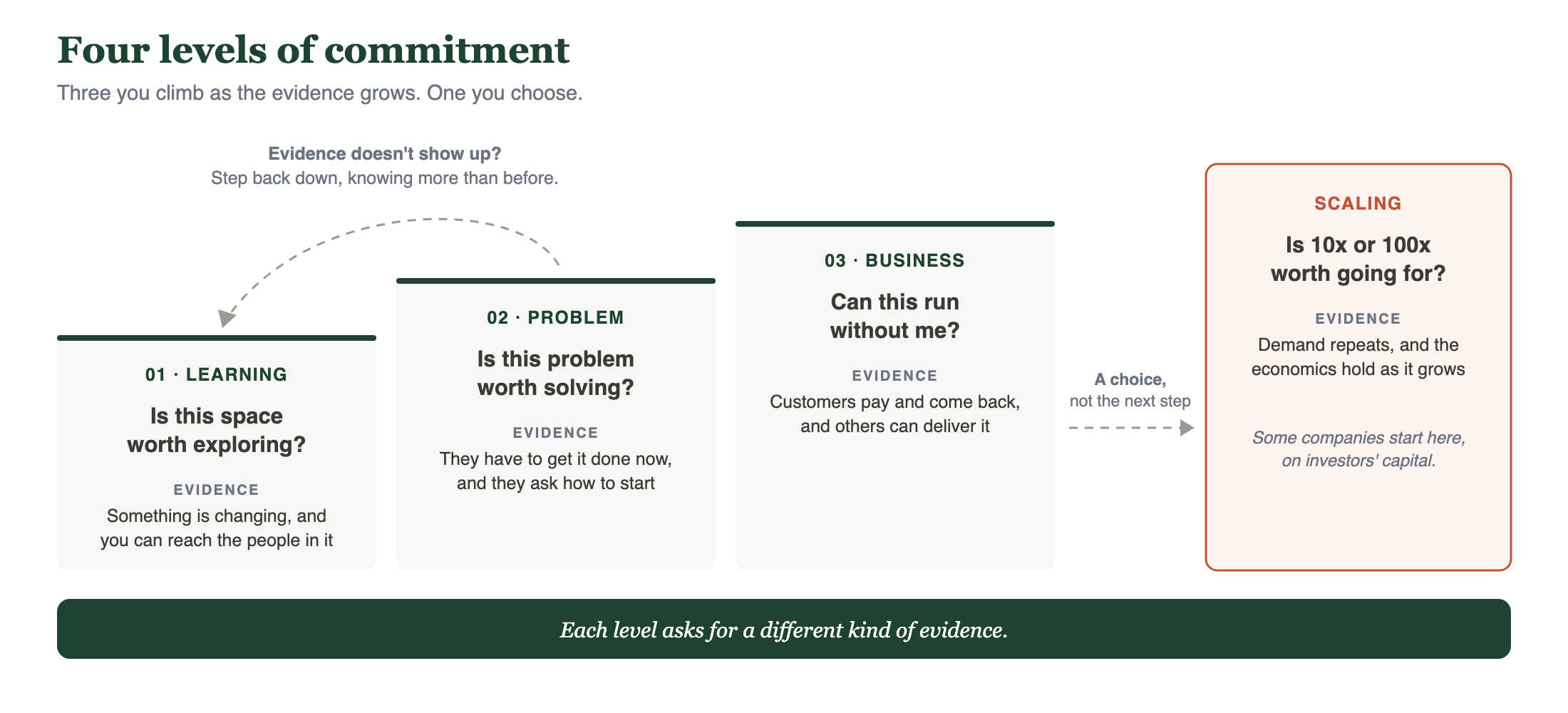
What follows is what I’ve learned so far, and a framing I’m experimenting with to decide how far to commit and to keep my energy from going everywhere. It treats commitment as four levels: learning, problem, business and scaling. Each level asks for a different kind of evidence, and at each one there is an assumption I’m rethinking.
1. Learning: “Someone is already doing it.”
At the first level you commit to a space: an industry, a technology, a kind of customer. What you put in is time and attention. The evidence you need is small, but it should be more than interest. Is something changing in this market? Can you get in front of the people who work in it?
This is where the first assumption usually ends things. Someone comes across an interesting idea, gets excited, does a little research, and discovers that a few startups are already working on it. The excitement disappears almost immediately.
There is a strong expectation that a startup has to be something new, and behind it a belief that whoever got there first has already won.
Being first is a head start, and in some markets it matters a great deal. But it is not the strongest moat. From the outside we mostly notice the company that won, and it’s easy to forget how often it wasn’t the first one there. Between a head start and a lasting company there are many more decisions: which customers to serve, what to build and what to leave out, how to turn demand into a business. A wrong call at any of them can give the lead away. From what I’ve seen, this is even more true in AI, where a first product costs much less to build than it used to and the ground shifts every few months.
What the company ahead of you does give you is information. It tells you that the problem exists and that customers may be willing to pay for a solution. Someone else has already spent the time and money to show that, and it is the kind of proof that usually takes months to earn. It also leaves you with a smaller question. In an empty market you are asking whether anyone wants this at all, and you are the one who pays to find out. With someone already there, the question becomes: what would you do differently, and for whom?
None of this means competition can be ignored, or that the company ahead of you will stumble. The same decisions are waiting for you too, and some markets do go to one winner, where arriving late with nothing different is a serious problem. But many markets support several companies serving different customers, and good businesses get built in markets someone else leads.
2. Problem: “I need a bigger and clearer vision of the end shape before I start.”
The startups we know best, we know after they have succeeded. By then the story is clear: where the company was always headed, and a founder who believed in it from the beginning. It’s easy to conclude that the vision has to come first. So people wait for an idea big enough and clear enough to justify the leap.
I’ve started to separate three things we usually pack into the word vision:
Conviction. What do I believe is changing in the world, and why does that create an opportunity?
Direction. Which customers or problems do I want to explore?
Destination. What will the company eventually become?
From the outside, the destination is the part of a successful company we see most clearly, so it’s easy to think it is the part to have first. It is usually the last to arrive. The second level asks only for a direction: you commit to one specific problem for specific people.
OpenRouter is an example I find interesting. It began in April 2023 with end users: a browser extension that let a person choose which AI model the web apps they used would run on. Within months it had turned toward developers, as a single API for reaching many models. Today millions of developers use it to reach hundreds of them.
Read it through the three parts. The conviction looks constant from the outside: there would be many models, and people would want to choose among them. The direction changed, from consumers to developers. The destination, a marketplace that sits between developers and the companies that provide the models, is something I doubt was visible from the starting point, along with the size of the wave it would ride.
So a starting point doesn’t have to look like the final company. One that doesn’t feel big enough can still be worth taking if it builds the relationships or the domain expertise that open up bigger opportunities later. The direction will change along the way, and even after a product finds its market there are more decisions about what not to do. That is part of entrepreneurship. You won’t know the end shape when you start. Of the three, what you need first is the conviction, and it can form while you are still learning.
What this level does ask for is evidence from the people who have the problem, and it is easy to misread, because interest looks so much like demand. What I look for is what Rob Snyder calls pull: the point where, in his words, “customers pull the product out of your hands.” His point is that people can agree a product solves their problem and still not buy it, because it isn’t the thing they have to get done now. You can hear the difference. Interest leans back: this is interesting, tell us more, maybe next quarter. Pull leans forward: wait, what can you do, and what would it take for us to start? Until you hear the second, the work stays at the first two levels: a different problem, or different people.
3. Business: “A great founder can make any idea work.”
When a startup succeeds, the story is usually told about the founder. Early-stage investors say something similar: at that stage, they are betting on the founder more than on the idea. So it’s tempting to conclude that the right person would have succeeded with almost any idea.
I don’t believe that. From what I’ve seen, a founder has two things to get right, and neither comes from being capable in general. One is finding the problem that is theirs to solve. The other is building it into a model that sustains itself, one that can grow beyond the founder’s own time.
The first is what investors call founder-market fit, and it is easy to read that as industry experience. Take the OpenRouter example again. Its founder, Alex Atallah, had co-founded OpenSea, a marketplace for NFTs. Crypto collectibles and AI models look like unrelated industries. From the outside, what the two companies share is the kind of problem: a marketplace layer in an ecosystem that is multiplying fast. The fit was in the kind of problem, and it wasn’t capped by industry.
I don’t know how much of that was timing and luck. But I do know that one of a founder’s core capabilities is choosing which problem to solve, based on their team’s strengths and the market. That fit is partly brought and partly built. You begin with what you know and who you know, and it grows as you get close to a problem.
The second is what the third level is about: you commit to building a company around solving the problem. The right problem can get you to customers who pay, and product-market fit tends to get found on the way here. Getting paid is an important signal. It doesn’t yet give you a business. Do customers consistently come back? And can it grow without you being the bottleneck? If every new customer takes more of your own time, growth stops where that time runs out. Plenty of good, lasting businesses work that way. To go further, the founder has to build what multiplies their time: a repeatable way to deliver the work, and people, agents or a process to carry it. From what I’ve seen so far, that comes down to a strong team. Agents let the team be smaller than it used to be. They haven’t made it a company of one.
You won’t have any of this when you enter the level. Building it is the work.
Both are worth a look if you are deciding whether to join an early-stage startup: the problem the founder chose, and whether the company can grow beyond the founder. I wrote more about that decision in Before You Leave Big Tech for a Startup.
4. Scaling: “A startup begins with a funding round.”
Most startups stay quiet until they raise, so the first time we hear about a company is usually the funding announcement. From the outside it looks as if that is where companies begin, and it’s common to hear that without venture capital, you can’t start.
From what I’ve seen, the order has reversed for most founders. A big vision and a deck used to be enough to raise money. Now most investors want traction and numbers, so you start first, and the raise comes once there is real demand to show.
A round is a commitment to scale, whenever you raise it: growth of a different order, ten times or a hundred times, at a pace your own revenue wouldn’t allow. It is more than a financing decision. It usually means a bigger ambition, faster expectations, and a company that takes a larger share of your life. Some opportunities call for that. They are huge, and if you don’t go all in now, you miss them. Some can’t be built at all without a great deal of capital up front. If that is the kind of problem you want to work on, the venture route is a promising one, and the right one.
But it is one route, and a choice. Whether an opportunity is a good one depends on what you want to build, and on the life you want while building it. There is no shame in starting something small with good cash flow. If the cash flow is strong enough to support the growth, a business like that can keep going without raising at all, even when it becomes very big. Mailchimp did it in software: twenty years without outside funding, then a sale to Intuit for about $12 billion. AI has made the possibility much more visible. Midjourney has never taken venture capital, and its founder said it was already profitable in its first year. I wouldn’t want the demands of one route to keep anyone from exploring entrepreneurship at all.
Learning to decide without certainty
Each of these assumptions takes something that is easy to see from the outside and uses it as a shortcut for judging an opportunity before there is enough evidence.
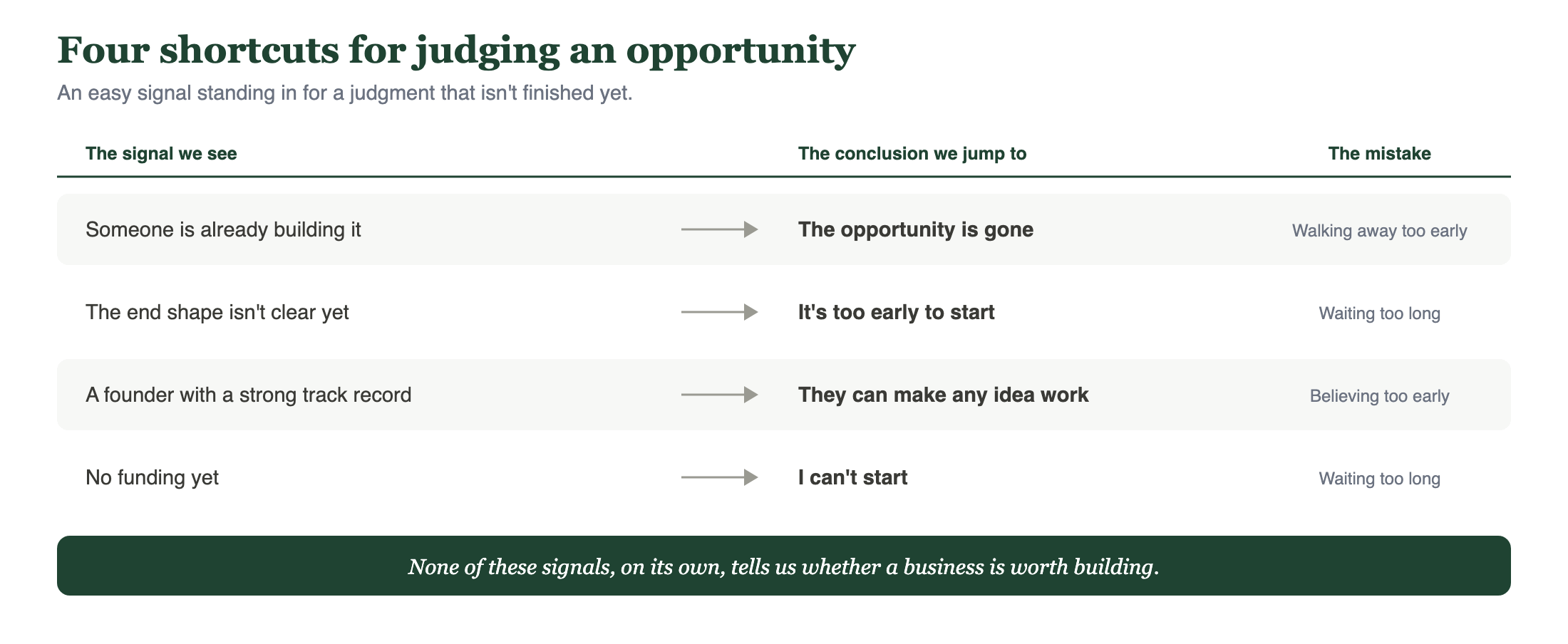
I’m still learning how to judge an opportunity without those shortcuts. Is this idea big enough for me to go all in? is a question about the third level or beyond. Many of the people I talk to are trying to answer it with first-level information. They have an interest and a hunch, and they are asking themselves for the certainty of someone with paying customers.
The better question is smaller: which level am I at, and what evidence would move me to the next one?
From the outside, entrepreneurship can look like one bold decision made with full certainty. From the inside, at least from where I stand, it looks more like many small ones: forming judgment as the evidence comes in, and committing a little more each time it does.
If you’d like to read what I learn next, subscribe to the newsletter. And if you think this helps someone else, pass it along.