
Recently, more and more people from big tech have been coming to me wanting to explore earlier-stage startups. Some are clients, some are friends. Over the past year or two, I’ve also watched more of them make the move. Many of them have spent years at big companies, and they tend to hold a few assumptions about startups:
You have to leave big tech to build something zero to one.
The earlier the startup, the harder the work and the bigger the payoff.
It’s the same job, just at a smaller company.
What’s driving the move is that big tech once felt like a reliable path to both stability and growth. Neither feels as predictable anymore, and the reasoning I hear goes something like this: big tech is already unstable and chaotic, plus the upside there is limited, so maybe time to join a startup?
What I notice is that after that long inside a big company, most people have no real picture of what a startup is. The word covers very different companies, and they are very different bets. And none of those assumptions hold up as well as people expect.
My own path went through a big tech company and then a pre-IPO company, which later went public. When I was deciding what came next, I interviewed with startups from Series A all the way to Series D before converging on the path I’m on now, building something zero to one. Along the way, I found that understanding the trade-offs between companies was the easier part. The harder part was knowing which trade-offs I was willing to make at this point in my life.
So here is the map first, and then the part the map can’t tell you.
The map
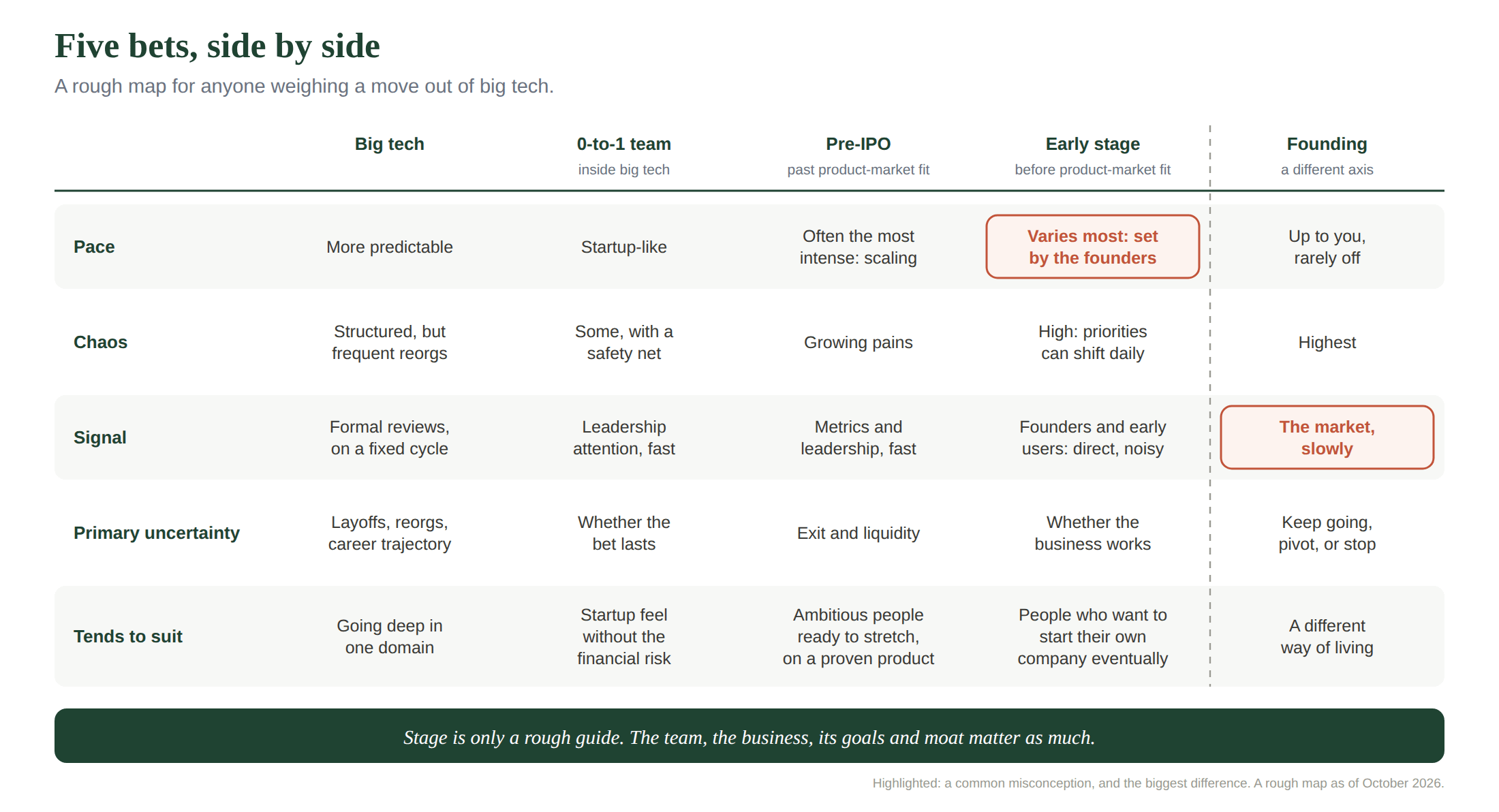
Here’s the whole map at a glance. The rest of this section is about what a table can’t show: where those assumptions break.
“You have to leave big tech to build something zero to one”
Big tech is still much more structured, and that’s hard to appreciate while you’re still inside it. Your impact may be limited, but what you deliver usually ends up adding some value. The catch is the constant reorgs. Teams, managers and priorities get reshuffled often enough that the structure itself keeps moving, and the project you care about can be deprioritized in the next one. Add the layoffs, and stability is no longer a given. It still suits people who want to go deep in one domain for a long time, it’s just no longer the safe default it used to be.
Ownership and energy aren’t only found outside, though. A 0-to-1 team builds something new from scratch, usually a bet the company is backing. If you want some of what a startup feels like without taking on the financial risk, it can be a good option: some of the pace and the newness, with a steady paycheck and liquid stock. It isn’t the same as a startup. You’re still working within corporate constraints, and the project can be canceled or deprioritized if the bet stops looking good.
“The earlier the startup, the harder the work and the bigger the payoff”
This is the assumption I’d push back on most, and both halves of it.
The work. In my experience, earlier doesn’t automatically mean busier. Before product-market fit, the main challenge is uncertainty: what to build, and whether it matters. Priorities change often, and a lot of the work never creates lasting value. The hours depend more on the founders and the culture than on the stage. Some AI startups openly hire for 70-hour weeks, and plenty don’t. After product-market fit, the direction gets clearer and the pressure shifts to scaling, which in what I’ve seen is often the more demanding stretch.
The payoff. Joining early means a bigger stake, and a much greater chance it never becomes valuable. Joining later means a more established business, but a smaller stake at a higher valuation. Neither is automatically the better bet. A pre-IPO company can offer an attractive balance of meaningful work and visible impact, but liquidity is never guaranteed, and getting there can take more than a decade.
The funding round. I couldn’t have drawn the line between rounds precisely either. Traditionally, Series A meant finding product-market fit and Series B meant scaling it, but in AI those lines have blurred. Look at the business itself. If you’re interviewing, ask: How long is the runway? Is revenue growing? Do customers stay?
“It’s the same job, just at a smaller company”
This is where most of the culture shock comes from. A startup role carries much more ambiguity in role and responsibility. Your title doesn’t speak for itself. And the way decisions get made, and the criteria behind them, tend to be very different from what you’re used to.
At a big company, seniority often means getting things done through other people and established systems: the org structure, the layers you delegate through, the cross-functional alignment, the processes and resources already in place. At a startup, you may need to move between setting strategy and doing the work yourself, sometimes within the same afternoon. The skills that made you successful don’t disappear, but the way you apply them has to change.
I’ve seen very senior leaders, VPs for example, struggle with this more often than people expect. It’s rarely about ability. The habits and assumptions built over years in big tech are hard to unlearn.
So I’d take this part slower than you think you need to. Company size alone doesn’t decide how well you’ll adapt. Someone who has built 0-to-1 products inside big tech may adjust faster than someone from a smaller but very structured company. What helps is knowing how different the operating model will be, and which habits you’ll need to let go of.
Founding isn’t on this line at all
People tend to picture founding as one step earlier than the earliest startup. I’ve come to see it as a different axis entirely, and the clearest way I can explain why is the scoreboard.
In most jobs, even ambiguous ones, there’s a system around you that helps define success: a manager, a promotion process, a business goal, a team that depends on your work. Whether it’s a review cycle, a metric or a leader’s attention, it tells you whether you’re on track.
When you start something from zero, that system largely disappears. Feedback still comes, from customers, usage and revenue, but it’s less structured, harder to read, and slow to tell you whether the business itself works. You decide what progress means. You can be in the dark for a long time, working very hard, with no idea whether you’re getting closer.
That’s why I think building from zero asks for a different kind of resilience, one that even very successful people may never have had to build. Without an outside scoreboard, the reasons that keep you going have to come from the inside.
Looking outward
Exploring all of these paths taught me that understanding the options is only half the work. You can learn everything about a company’s stage, funding and upside, and still make the wrong choice for yourself.
It’s tempting to choose based on what looks best from the outside: a bigger title, a more promising company, an IPO that could change everything. But none of those outcomes are in our hands. And when they don’t arrive, it’s easy to look back and feel that the years were wasted.
Looking inward
Looking inward is harder, and often less familiar. Many who try run into the same wall: I don’t know what I like. It’s hard to know what you’d love when you’ve mostly been asked what you’re good at. In my experience, this is especially common among Asian professionals, many of whom grew up being asked what was practical and respectable long before anyone asked what they liked.
So looking inward doesn’t have to start with passion. It can start with questions you can answer today:
What did I want from work ten years ago, and what do I want now?
Five years from now, what would I regret not having done, even if the company fails?
When did I last lose track of time? What did I keep doing even when nobody asked?
Choosing from the inside doesn’t protect you from disappointment. But it lets the experience itself have value, even when the outcome doesn’t work out.
Not everyone has the same room to choose this way. A mortgage, a visa, a family that depends on your income: these are real, and external conditions are a reasonable floor. The question is whether they are also the whole compass.
The things with a deadline
Looking inward also means admitting that work is one part of a life. Parents get older. Children grow up. Those years have a clear end date, and once they’re missed, they don’t come back.
My own last move leaned this way. At this stage of my life, I put flexible hours and a wider range of life experience ahead of higher pay or a bigger title. Flexible hours, so I can volunteer at my kids’ school and be there when my parents need me. A wider range of experience, because I don’t want to live just one career for my whole life. The hours aren’t short, but I decide when I work.
Choosing this way doesn’t mean giving up on ambition. What you’re ambitious about can change from one stage of life to the next. It does take more courage. Outward has a scoreboard everyone understands. Inward has none, and to other people it can look like a step back.
So alongside the map, it’s worth asking a quieter question: what in my life has a deadline?
Careers take unexpected turns. Companies succeed or fail, and opportunities come around again.
Some seasons of life don’t.
If you’re in the middle of a decision like this and want a thought partner, I’d be happy to help. → amywucoaching.com