
Lately, when I talk to friends and clients in corporate environment, the mood is heavy. Layoffs in the Valley. Uncertainty about what’s next. A sense that the ground could shift again at any moment. Most of the conversations sound the same — anxious, pessimistic, bracing for the worst.
But one conversation was different. A client of mine told me, with genuine energy, that this period has actually broadened her career — not narrowed it. She’d been intentionally challenging herself. Picking up new skills. Exploring adjacent roles she never would have considered two years ago. She wasn’t ignoring the uncertainty — she was using it. Where most people saw doors closing, she saw new ones opening.
That contrast stuck with me. Not because I think everyone should feel optimistic right now — that would be tone-deaf. Many people are exhausted. They’re managing real fear about their jobs, their finances, their futures. The thought of “reassessing your career” when you’re already running on fumes can feel like one more impossible ask.
I hear that. I respect it. And I’m not here to add to anyone’s plate. But I do want to share why I believe the people who check in with themselves regularly — even in small ways — are the ones who’ll come through this era stronger. Not because they have it all figured out. But because they’re paying attention.
The ground is moving faster than we think
We’re living through one of the most significant shifts in what work looks like since the internet went mainstream. New roles are being invented — ones that didn’t have names two years ago. Other roles are shrinking or being reshaped so fundamentally that the job title stays the same but the actual work is unrecognizable.
The old rhythm of reassessing your career every three or four years made sense when industries shifted slowly. But that cadence doesn’t match the world we’re in anymore. I’d argue we need to check in with ourselves at least once a year — not to panic, but to stay intentional.
AI changed more than the job market — it changed how fast you can learn
Here’s the part of the story that doesn’t get enough attention: the barrier to learning new things has dropped dramatically.
I’ve experienced this firsthand. Over the past few months, I’ve picked up skills across both work and life — marketing, product design, trading & investing etc. — that I would have struggled to develop on my own five years ago. Not because I suddenly got smarter, but because AI tools made the learning curve less steep. I could ask questions, get immediate feedback, iterate quickly, and build real understanding — not just study theory.
This matters for career reassessment because it changes the math. The cost of exploring a new direction used to be high: go back to school, spend months in a bootcamp, invest thousands of dollars before you even knew if the new path was right. Now, you can start learning and experimenting with a fraction of that investment. The entry point is lower. The speed is faster. The excuse of “it’s too late to learn something new” holds a lot less weight.
That said — and I want to be honest here — having access to tools doesn’t automatically mean you have the time or energy to use them. If you’re working full-time, managing a family, and already running on fumes, “just go learn something new” can sound like one more demand on a list that’s already too long. I’m not here to add to your overwhelm. I’m here to offer a way to think more clearly about where your energy goes.
A simple framework for checking in
When I work with clients on career direction, I keep coming back to three questions. Think of them as three overlapping circles:
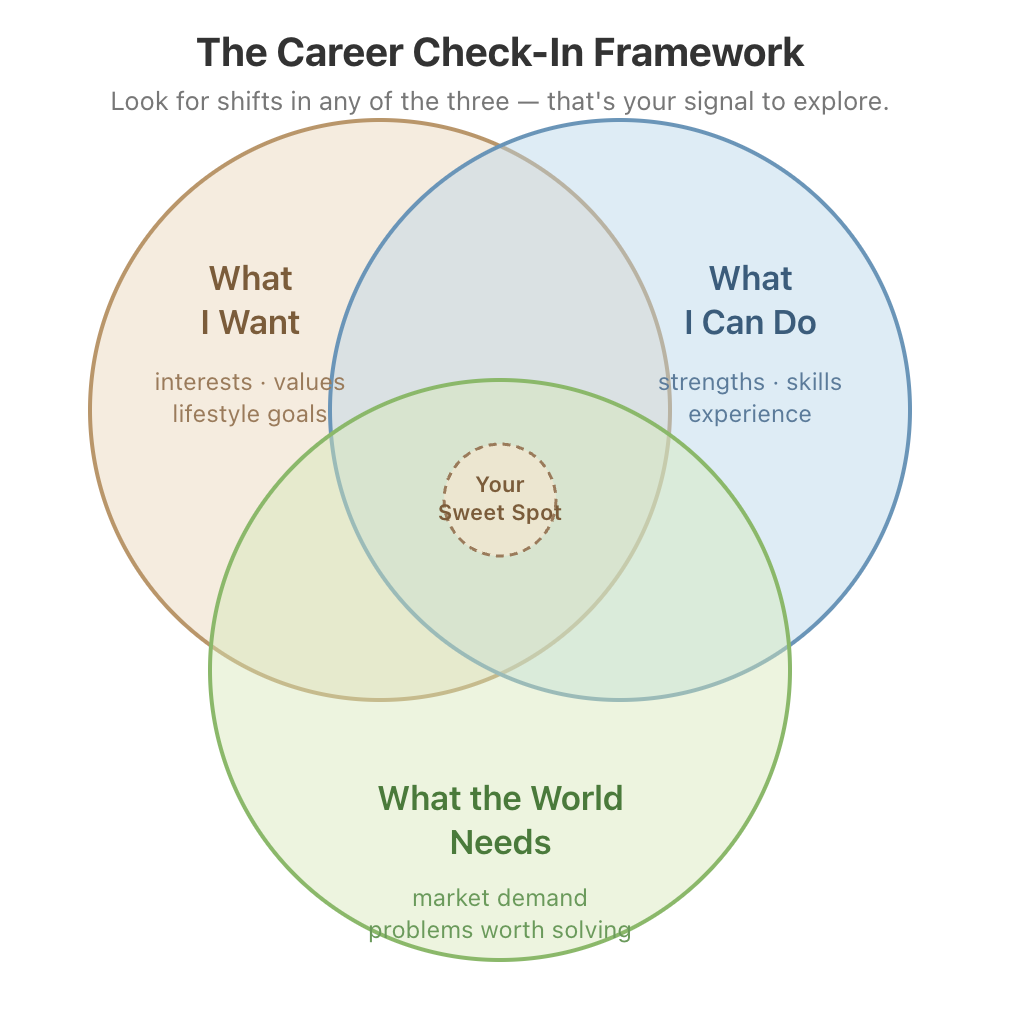
The sweet spot lives in the overlap of all three. But more importantly, the value of this framework is in noticing when one of the circles has shifted. Maybe your values changed after becoming a parent. Maybe your industry is contracting. Maybe a skill you’ve been developing suddenly has a market you didn’t expect. Any shift is a signal to explore.
This framework won’t hand you an answer. But it gives you a starting point — a way to move from vague dissatisfaction or anxiety into something more structured and honest.
Small steps, not a leap
I want to be clear about something: I’m not encouraging anyone to constantly chase the next thing. Job-hopping for the sake of novelty creates its own kind of instability. And I’m definitely not suggesting you need to blow up your life to make progress.
What I am encouraging is small, intentional steps. Check in with those three circles. Notice what’s shifted. Have one conversation with someone in a role that interests you. Spend twenty minutes reading about a skill that’s been on your mind. That’s it. That counts.
One pattern I see often in coaching: people feel pressure to figure out their next move all at once. They want clarity by next month. A new title by next quarter. But career design doesn’t work like that. It’s entirely reasonable to spend up to a year reflecting on how you want to invest the next four years of your life. That’s not indecision — that’s proportional thinking.
Your career isn’t a single straight line — and it was never supposed to be. It might be a series of chapters. Some build on each other directly. Others take a turn. Some might involve a primary role plus a side project, or a portfolio of skills that meet different needs in your life.
The old model — climb one ladder, stay loyal, retire — worked when the ladder was stable. But ladders are shifting now, and the people who thrive will be the ones who keep iterating. Not rushing. Not overhauling everything at once. Just staying honest with themselves and designing a path that supports not just their income, but their happiness, fulfillment, and financial sustainability.
You don’t need to have it all figured out. You just need to take the next small step.
About Myself
I’m an executive and life coach who helps leaders grow with clarity, confidence, and purpose. If something in this post resonated with you — or if you’re navigating a career transition that could use a thought partner — I’d love to connect.