
More and more people have been describing this to me — in coaching conversations, over catchups, on walks with friends, in voice notes that have started running longer than they used to.
They do not always call it that. They tell me they are getting burned out. They tell me the work doesn’t satisfy them the way it used to. They tell me it is not easy to build relationship at work nowadays.
From the outside, it sounds like they are each working through something different. As we keep talking, the thread is always the same.
The thread is loneliness.
A loneliness that doesn’t look like loneliness
Look at your calendar this week.
You probably had a standup. A 1:1. A sync. A review. Another 1:1. A coffee that was actually a status update. By Friday at five you had been in back-to-back rooms with humans for forty hours. And there was a particular kind of hollow you felt when you closed your laptop that you didn’t have a word for.
It was not exhaustion, though you were tired. It was not failure, because you shipped what you said you would ship. It was something else. Something that got quieter the longer you ignored it.
What I started to see is that most of us cannot name this for what it is — because how could you be lonely with that many people in your week? But the thing your body kept noticing, the thing that left you flat by Friday, was a loneliness that had nowhere to go. You had been with people. You had not been in anything with them.
What I started seeing
I came across a framing recently that finally gave me language for this. It described the relationships in our days in three modes:
A unary relationship is us and something that doesn’t push back. AI is the most powerful example we have ever had, but a scrolling feed is unary too. We act, it answers. No other party in the room.
A binary relationship is us and another person, but the interaction is transactional or shallow. We trade information and move on.
A ternary relationship is us, another person, and a shared third thing we both actually care about — a craft, a problem, a stake.
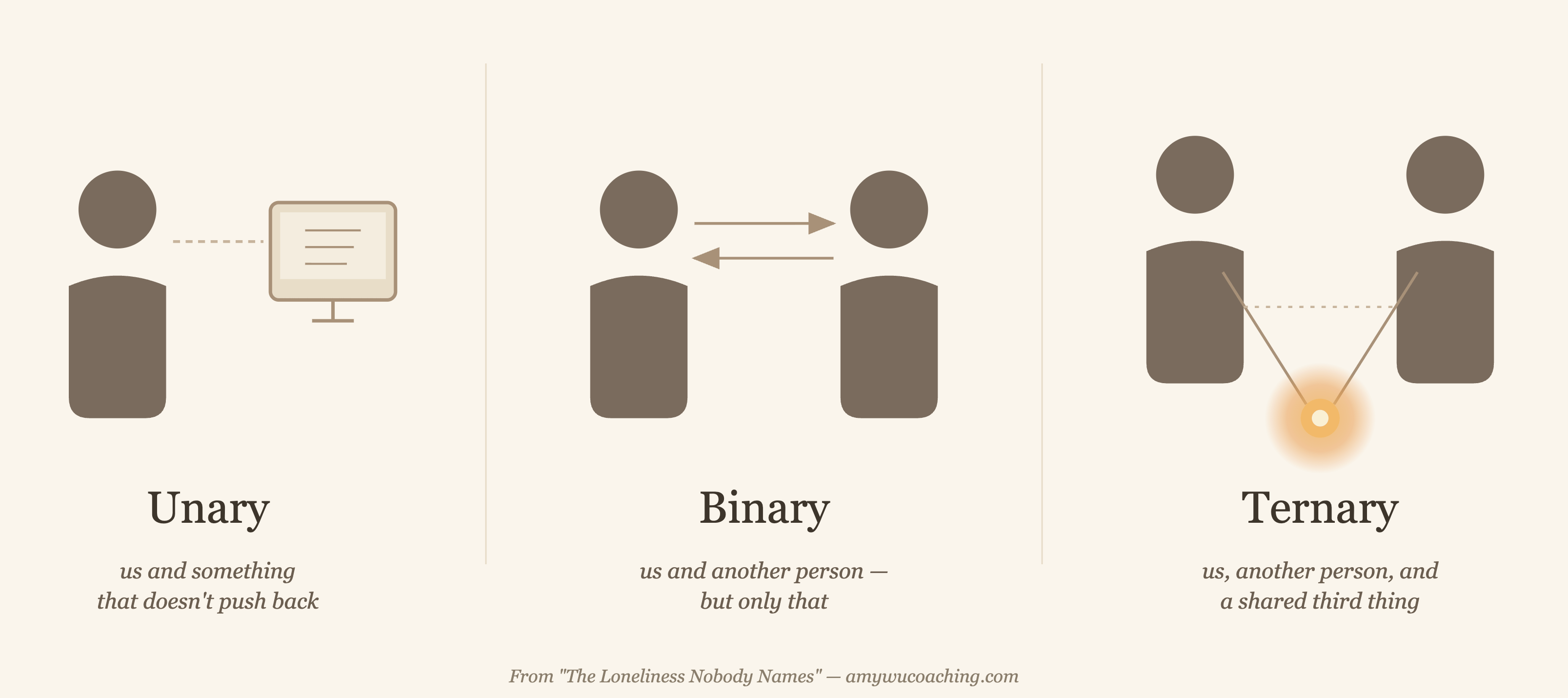
The diagnostic clicked the moment I sat with it. Most of the people I had been listening to — the clients, the friends, myself — were not short on people. We were short on ternary.
You can have ten meetings in a day, three hours with AI, and zero rooms with the third thing inside. That is the shape of a binary day. From the outside, you look fully booked. From the inside, you are not being seen.
Why this got so hard
Ternary used to form on its own.
Real working relationships used to compound by accident — long projects with the same team, shared offices, shared frustrations, shared after-work drinks. The product you were building was the third thing. You disagreed with each other in ways that cost both of you something. You came back the next Monday anyway.
That scaffolding has been quietly disassembled. Sprint-sized teams, faster reorgs, remote work compressing the casual ternary moments into nothing. People did not stop wanting workplace closeness. The structure that produced it stopped existing by default.
Layered on top of that, a sharper pressure showed up. AI-era stack-ranking and rolling layoffs have changed what the room feels like. When the question in the air is who is replaceable, you stop leaning into the long, generous conversations that ternary requires. You protect your context instead of sharing it. You keep your guard up. The third thing needs both people to lower theirs. That has gotten genuinely scarce.
Then unary arrived. AI is the most powerful unary relationship I have ever had. It is fast, frictionless, available at 11 pm, and it never disagrees with me in a way that costs either of us anything. When I am tired on a Thursday at six and there is a community event across town, the trade-off looks obvious. I will catch the next one.
I caught the next one less and less. Many of us did.
You cannot accidentally find yourself in ternary anymore. You have to go looking for it.
How I’m looking for ternary now
This is why I have been actively setting time for the relationships that used to form without effort.
I schedule lunch and coffee with specific friends — the ones I am inside the same chapter with, the ones whose problems rhyme with mine. I invest real time in the communities I am part of — showing up regularly, giving back where I can. My coach cohort has given me coach buddies and steady support, which has meant I am not walking through any of this on my own. I have stopped asking whether community time is “worth it” in any productivity sense, because that is the wrong question. The right question is: is this the kind of room where the third thing can show up?
What I get in those rooms is not information. Information is everywhere. What I get is the experience of being seen by someone who is inside the same thing I am. The kind of seen you cannot purchase, cannot accelerate, and cannot replace with a great prompt.
That kind of presence has become a luxury. Not the spa kind. The kind that means rare, slow, and worth structuring your life around.
What this is showing me about coaching
One of the real missions of coaching, I have come to believe, is helping with this loneliness — by exploring something hard together with someone, instead of letting them face it alone.
The relationship inside coaching is itself ternary. There is me. There is the person I am working with. And there is the real third thing we are both inside — a transition, a decision, a piece of their own becoming. The conversation has stakes for both of us. That is what makes it generative, not transactional.
A lot of what coaching gives people is courage — the courage to make the choice, to have the conversation, to take the step that felt impossible to take solo. But what I have come to believe is even more meaningful is what comes after the courage: helping them notice and build the supporting systems and high-quality relationships in the rest of their life, so they are not relying on courage alone. Courage gets you started. The room around you is what carries you through.
What this has done for me
I am not saying ternary is the most important thing you can build. There are real fights for your attention right now — work that matters, people who depend on you, hours that are not yours to give away.
But I want to tell you what this has done for me. Investing in these rooms — the communities I show up to, the coach cohort, the long lunches with friends sitting in the same chapter as me — has changed my mental health. It has changed the shape of my weeks. It has made me feel more like a person and less like a system.
If your week has been full and you have been quietly hollow on Fridays, you are not broken. You are short on ternary.
And you do not have to fix that alone.
About Amy Wu
I coach leaders and builders navigating identity rewrites in the AI era. If something here landed, I would love to talk.