
“Our AI adoption is reasonably good. But it’s not translating into any real execution velocity.”
I’ve heard a version of that from almost every org leader and business owner who has made good progress on AI adoption. Earlier this year, the energy ran in the other direction — a big wave of chasing AI-tool adoption: usage dashboards, internal leaderboards, what percent of the team was on Claude or Cursor by Friday. Lately some of the more advanced companies have started to pull back. Uber is the clearest public example: after driving AI usage to nearly every engineer, it capped per-engineer spending when it couldn’t connect all that usage to the business actually moving faster. The pullback isn’t because adoption was a mistake — it’s that they’ve already claimed that fruit, and found it was the straightforward part of the puzzle. Driving adoption isn’t nothing; it’s just one piece, and the easier one. The harder parts are still sitting there untouched, which is why the usage charts can climb while the business moves at the same speed it always did.
I’ve spent time on both sides of this. I know how organizations and their processes were built in the pre-AI era, and I’m now building — and helping others build — toward AI-native. From that seat, the gap is hard to miss. So the pullback doesn’t surprise me.
What companies actually compete on now
For the last twenty years, “going digital” was mostly about getting things online — information online, process online, data online. That race is largely over; most companies finished it. The next decade looks different. What increasingly separates companies isn’t who has the data. It’s how fast they can learn, decide, and execute.
That’s the shift most adoption plans underestimate. AI isn’t only changing how individual employees work. It’s changing how the whole organization runs.
The biggest cost has flipped
Think about what used to be scarce and expensive: building things, R&D, getting information. Those are exactly what AI is making cheap — content, analysis, software, research, all dropping in cost by the month. What’s scarce now sits one level up: management attention, how well the organization coordinates, the quality of its decisions, the speed of its execution.
Building keeps getting cheaper. The hard part is the coordination around it — and that’s what the next era of competition turns on.
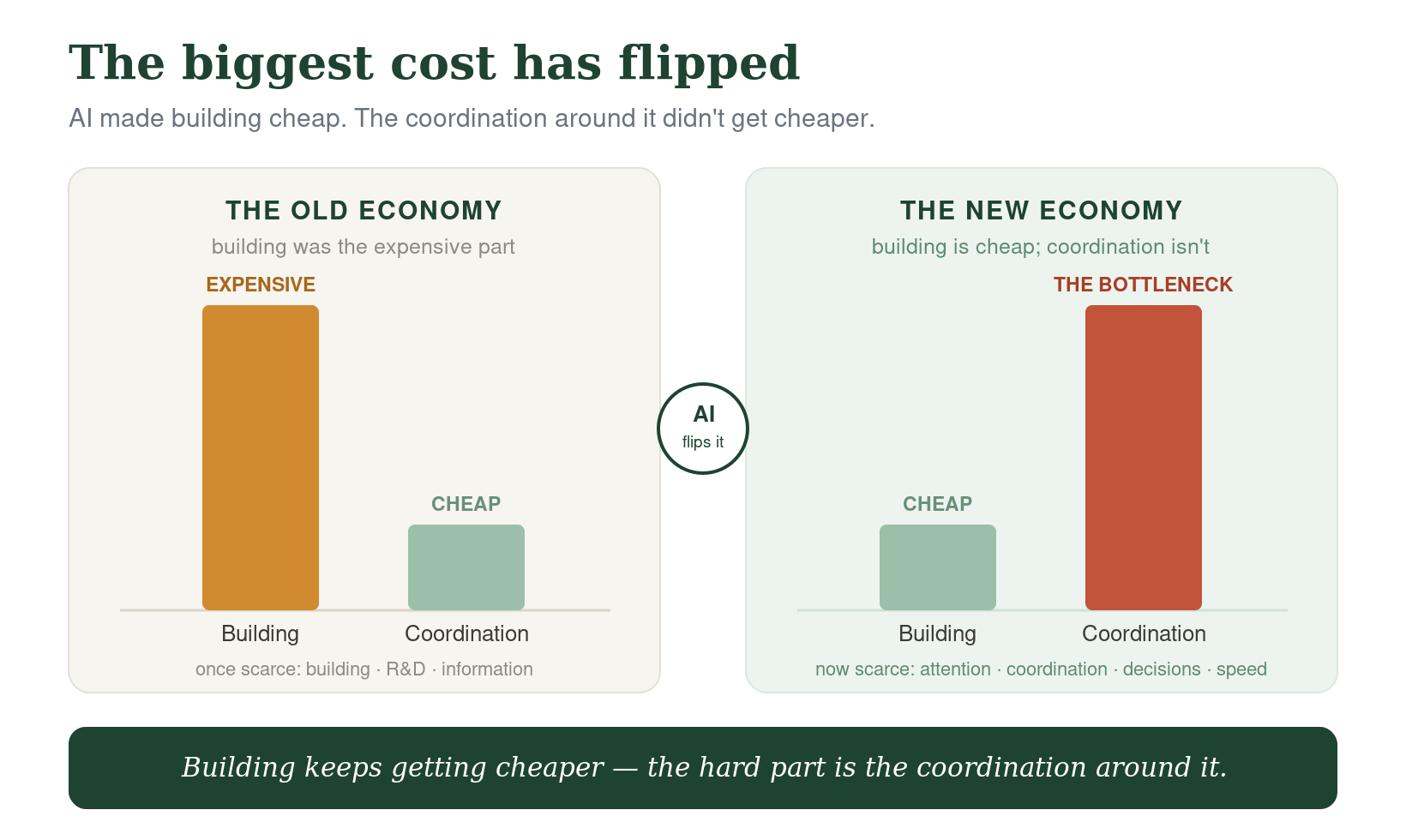
This is why pouring AI into the existing org doesn’t move the top line. You speed up the one part that was already getting cheaper — the building — while everything around it stays exactly as slow as before. The new speed runs straight into the old coordination and piles up there.
What “AI-native” actually means
Strip it down, and an AI-native company is one where the absolute core of how the organization functions — its operations, execution, scaling, and cost structure — is built around AI, not bolted onto a structure designed for a world without it.
Most companies aren’t there, and that’s fine — it’s a spectrum, not a switch. At the far left are companies barely using AI at all; that’s the starting line, and plenty are still standing on it. Past that, three markers matter:
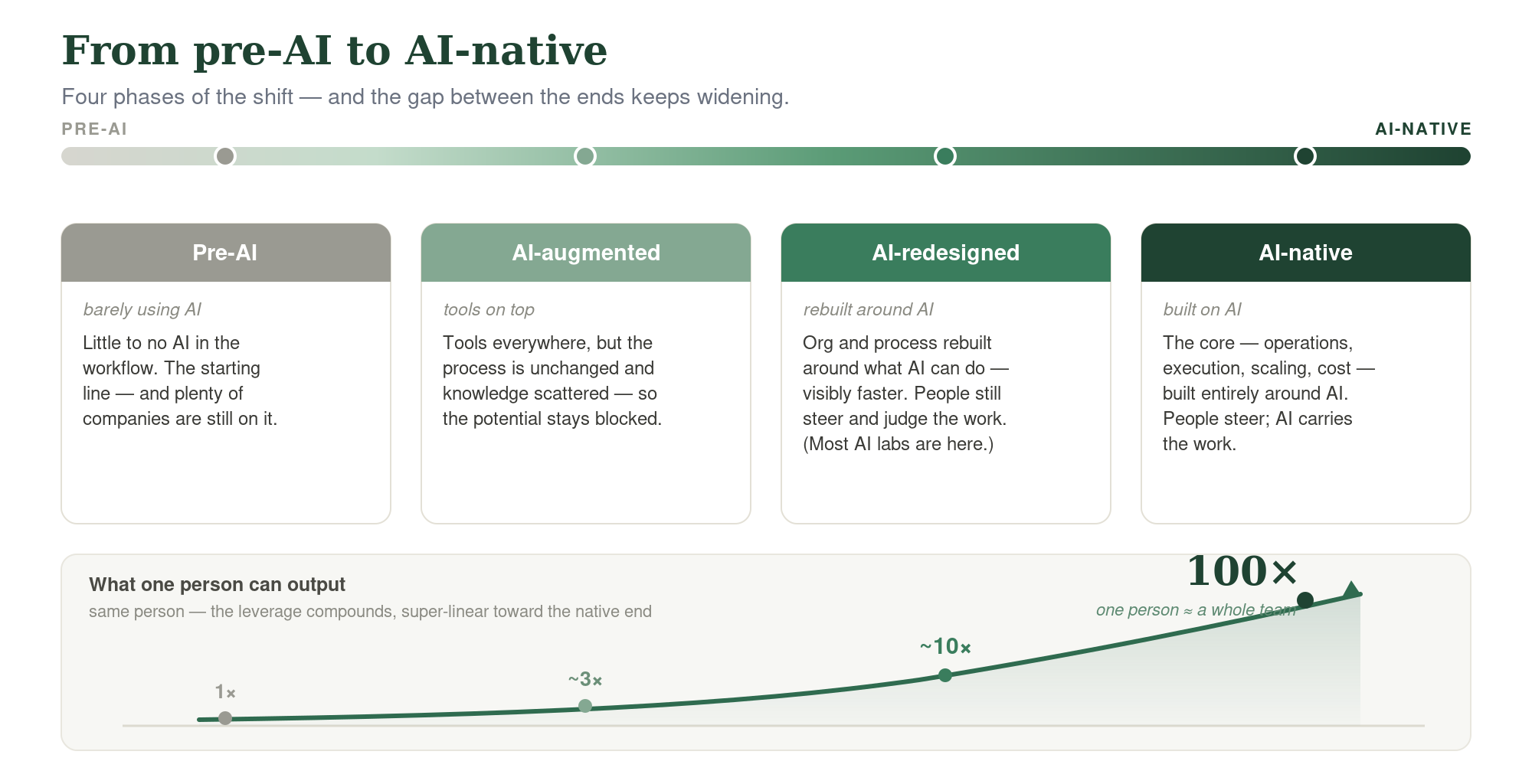
AI-augmented — tools on top. Everyone’s using the tools — Claude, Codex, Cursor, Copilot. Getting even this far is real work; rolling tools out across a whole company is genuinely hard, because change is hard. But the processes are still designed around how people work, and the knowledge is scattered — so the tools can’t yet show what they’re worth. This is the augmented end: AI bolted onto an organization built for a pre-AI world.
AI-redesigned — rebuilt around AI. Process and organization rebuilt around what AI can actually do, and visibly faster for it — roughly where most of the AI labs themselves operate today. Worth being precise here: even at this stage, people are still at the center of execution — steering the work, judging it, owning the calls. The speed comes from the redesign, not from removing the humans.
AI-native — built on AI. The far end — what some are calling the one-person company. The core of how the organization runs is built entirely around AI: it carries most of the decisions and execution, while people focus on bringing in outside signal and steering the whole system.
The line that matters runs between the first point and the rest. The augmented end treats AI as a tool layered on top of the existing process. The other end rebuilds the organization around it. That is the key difference between AI adoption and AI transformation.
And notice how little of that line is about token consumption — about how much AI you use. It’s about who owns what, where decisions actually get made, and where the company’s knowledge lives.
Why most companies are stuck at the augmented end
And here’s the answer to the puzzle I opened with. The reason adoption isn’t showing up as speed is that most companies are parked at the augmented end — tools bought, everyone using them, and the potential still bottled up.
It isn’t a technology problem. MIT’s 2025 study of enterprise AI found that 95% of generative-AI pilots delivered no real return — and concluded the gap wasn’t model quality but organization.
The list of blockers is long — the usage charts are just the tip. Below the iceberg waterline sit incentives that reward usage over outcomes, a culture where everything waits on approval, context scattered across a dozen tools, and more. Two of them are load-bearing:
The process was built for pipeline. Reviews, approvals, alignment meetings — all designed around how humans coordinate, not around what AI can do. Push AI into that, and you get small patches, not a step change.
The knowledge is trapped in individuals. The experience and judgment that actually matter live in meetings, chat threads, and people’s heads. AI can’t reach any of it, so its output stays generic.
The gap, in other words, isn’t the tools. It’s the process and the knowledge.
The way across
Moving off the augmented end starts in one place: getting the organization’s knowledge out of scattered heads and meetings and into something durable — a corporate second brain that captures the company’s decisions, experience, and judgment, and feeds them continuously back to the AI. That’s the foundation the rest stands on. When the organization can actually learn — not just type faster — the speed finally reaches the top.
How to build that second brain — what to capture, how to structure it, how a single decision becomes something reusable — is what I’ll be writing about across the rest of this series.