
People tell me I’m good at building rapport and collaborations, and they ask me what my secret sauce is. The truth is, it’s not something I was born with. It’s a learned skill — one that took years of practice.
The Whiteboard
In my first year as a manager, I got thrown into the deep end — and I was bad enough at it to have plenty of sleepless nights.
I’d walk into those rooms with my case prepared. The partner team that disagreed about priorities. The peer who wanted my team to absorb their work. The colleague pushing back on a roadmap I’d already committed to. I’d sit down ready. Somewhere along the way the room would tense up — I couldn’t tell you exactly when — and by the time we wrapped we’d be no closer to anything than when we’d started.
Eventually I went to the VP I trusted for advice — the one who’d seen my management potential and convinced me to step into the role. I sat across from him in his office and told him I couldn’t figure out what I was doing wrong. The case was sound, I said. The data was clear. Why was every conversation a fight?
He shared a metaphor that stayed with me. I still borrow from it every time I walk into a hard conversation:
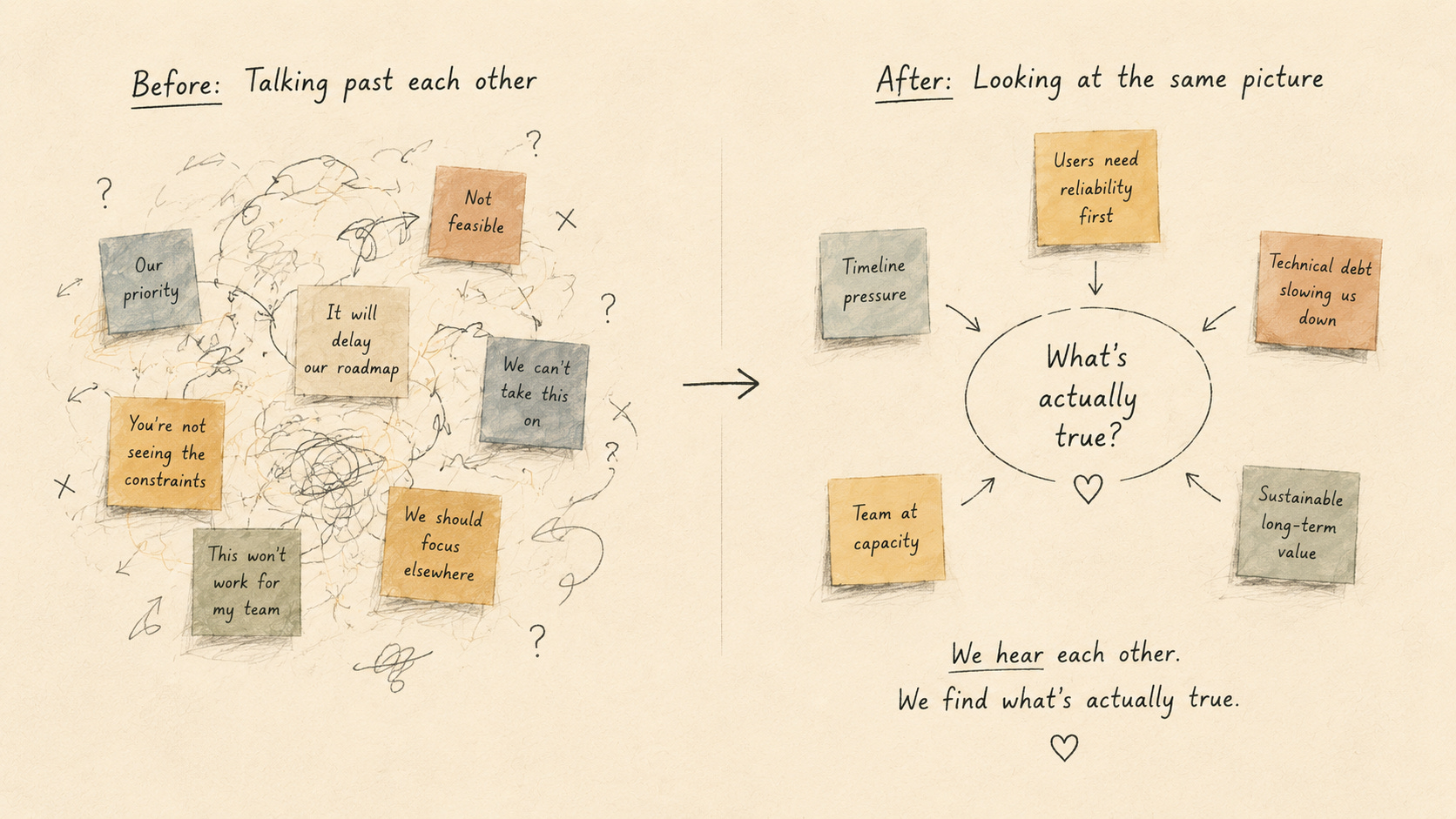
“We both walk into the same conference room. There’s a whiteboard. Each of us puts a point on it. Then we sit together and look at the points as if they don’t come from us. We filter the noise and come to a conclusion. It’s that easy.”
I remember thinking: that doesn’t sound easy at all.
But something settled in me as he said it. The metaphor was an aha — and it gave me a frame I’ve come back to ever since. The whiteboard wasn’t a meeting tool. It was a way of being in the room. And the goal of these conversations wasn’t what I’d been chasing.
I’d been treating every conversation like persuasion. I needed peers to agree with me. When they pushed back, I pushed harder.
Influence without authority isn’t persuasion. It’s partnership.
The goal is to be heard, to hear them, and to look at the same picture together so you can both see what’s actually true. When that happens, the answer is usually obvious — and neither of you had to lose anything to arrive at it.
The frame gave me the picture. What I didn’t have yet were the moves. That part took years — paired with what I learned from negotiation books along the way. The one I keep coming back to is Chris Voss’s Never Split the Difference. Slowly, both became muscle memory.
Voss names the signal you’re looking for. Not “you’re right” — that’s what people say when they want you to stop talking. The one to wait for is “that’s right.” That one means they feel fully understood. They recognize their own situation in what you’ve just said. You didn’t convince them. You both finally saw the same picture.
Why My Point Wouldn’t Leave My Hands
Even once I had the frame, two things still got in the way. The harder one — the one that took me the longest — was learning to let my point leave my hands.
I couldn’t do that at first. I’d done the analysis. I knew the answer. When I put my point on the table, it didn’t feel like one data point among others on a whiteboard. It felt like a position I was defending. The moment someone pushed back, my chest would tighten and I’d start defending it harder.
I see this now with the technical leaders I coach. The more capable you are, the worse this gets. You see the answer faster than the room does. You’re not trying to dominate — you’re trying to help. But the other person feels called out, or steamrolled, or audited. They get defensive. The room tenses. The whiteboard never gets used.
The move I learned, slowly, is labeling — naming what the other person seems to be feeling, before defending anything. “It sounds like you’re worried this timeline puts your team behind.” “It seems like the framing of this rewrite undermines a commitment you’ve already made.”
What I started to see is that most people aren’t actually arguing about the question on the table. They’re carrying something else — a constraint, a worry, a commitment — that they haven’t said out loud. Labeling invites them to say it.
The aha for me was uncomfortable: my certainty was the obstacle, not the asset.
The Question I Kept Forgetting to Ask
The second thing was their point. I needed it on the whiteboard fully visible — and I almost never had it.
I’d come out of meetings thinking I’d heard them. They’d told me what they needed. We disagreed. Done.
But sometimes months later, sometimes years later, I’d learn the actual concern had never been on the table. A budget pressure they didn’t want to admit. A commitment they’d made to someone above them that they couldn’t undo. A career anxiety I hadn’t sensed. The surface concern they raised was real, but it wasn’t the load-bearing one. The whiteboard had been half empty the whole time.
The move is calibrated questions — open-ended questions starting with what or how that the other person can’t answer with a yes or no. “What about this matters most to you?” “How does this fit your bigger picture?” “What would have to be true for this to feel like a fair tradeoff?”
Years before, sitting in on sales calls as an engineer in a cross-functional rotation, I’d watched the best salespeople do exactly this. They weren’t selling. They spent something like 80% of the session asking the client about their pain. They were filling the whiteboard with the client’s points before adding their own. The clients didn’t see them as sellers. They saw them as partners.
The Sequence I Use Now
This is the playbook I use now. Some people call this active listening — and it overlaps with that — but the frame is bigger. You’re not listening to win the conversation. You’re listening because the answer hasn’t been assembled yet.
Step by step:
Start with partial intention. Both of you walk in with an incomplete picture. The conversation is the work of assembling one.
Listen to understand, not to respond. Ask until you find the unmet need they didn’t want to say out loud.
Reframe to confirm you got it. Say back what you heard — the feeling and the unstated challenge. Watch for “that’s right.”
Lay out your challenge. Once they feel heard, put your point on the board. Invite them to brainstorm with you, not pitch them on it.
Let their opinion shift on its own. They have the full picture now. They may move without you trying to move them.
Walk the pros and cons together. Both points on the board, no ownership over either. Filter the noise.
The answer usually surfaces. Neither of you had to lose anything to get there.
Looking back, this is the most fundamental skill I know — the one underneath every conversation where the stakes are high. The hard ones at your dinner table that could have ended in distance, and didn’t. The hard ones in your conference room that could have ended in defensiveness, and didn’t. Build this once and it works in every room with another person — for the rest of your life.
What to Try This Week
Pick one conversation this week where you already know you’re “right” — where you walked in with a clear point and walked out wishing it had gone differently.
Then ask yourself:
Did I bring my point as conviction — or as a point on a whiteboard? Did I ask enough about theirs to actually see it? And when we wrapped, did I hear “you’re right” — or did I hear “that’s right”?
If those questions are sticky, that’s the kind of thing a 1:1 conversation can help you walk through.
It’s that easy. And it’s also that hard.
Thank you, Chencheng, for capturing this so beautifully. Even though you shared it with me during our coaching session, I still find it deeply insightful and very resonant.
Thank you — this means a lot. I'd been getting this question from enough people that I figured it was time to put it down. Looking back, it's one the most valuable investment I've ever made to my career so I want to help more people learn about this influence framework. Hearing it land for you the second time means it's becoming yours — and that is what motivates me to continue the sharing and paying forward.