
I’ve been having a lot of similar conversations lately — with clients, with friends, with people I meet at events. Different surface details every time. The underneath rhymes.
Different versions of the same question keep coming up. Am I doing the right thing? Should I be more worried than I am? Or less? The person with the stable team is asking it. The person scrambling after a reorg is asking it. The person who just walked into a smaller team on purpose is asking it.
What’s new isn’t the shape of the question. These are classic transition states that mid-to-senior tech leaders have moved through for as long as I’ve been around the industry. What’s new is the intensity. AI is disrupting paths people built careers around, and introducing new possibilities nobody has a playbook for yet.
That’s why the old categories don’t sort people the way they used to. I see comfortable people quietly eroding and struggling people who are visibly growing. Nobody is fully comfortable right now — every state has its own pressure underneath, and most of the people I talk to assume theirs is the worst kind, because they can only see their own.
I’m putting this map down in case it’s useful. Not as a prescription. As a way to see where you are, recognize you’re not alone in being there, and find the work that’s actually yours from that state.
Four states
Here’s the map I’ve been carrying into these conversations lately. Four states I keep seeing people in — I’ll call them Stable, Drained, Misaligned, and Stretched. Each has a real shape, and each one has its own form of anxiety underneath. The work to do is different from each one.
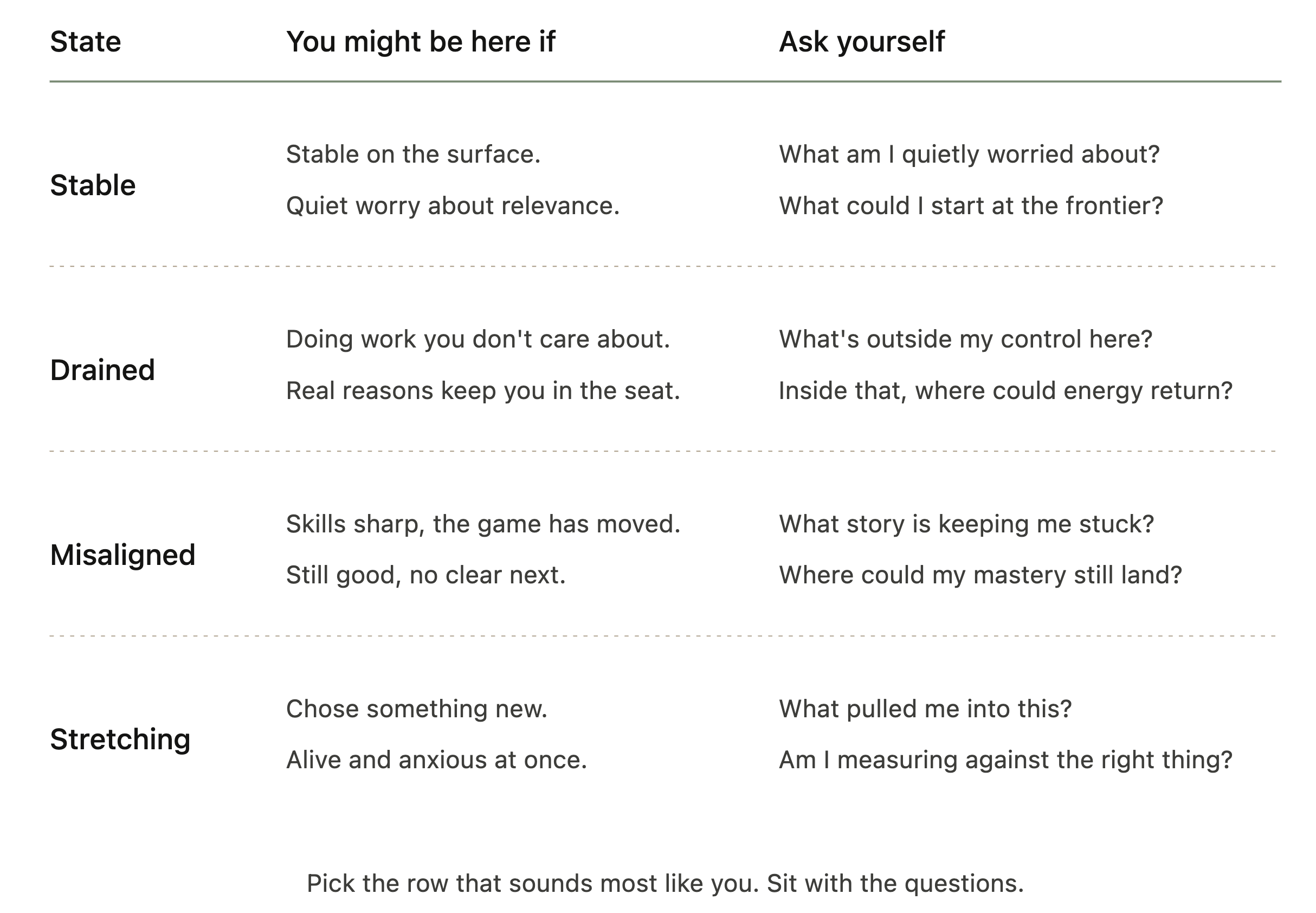
Stable — and quietly worried about it.
From the outside, you have it good. Supportive leader, team that runs itself, no fires this quarter. From the inside, you’re not at ease. The comfort itself is what’s bothering you — a low background hum that asks: if the world is changing this fast, what is it costing me to be this stable?
You’re not burned out. You’re not behind. But you can feel something shifting in the field around you, and you can’t tell yet whether your steadiness is a foundation or a hiding place. The anxiety is ambient — future-tense, abstract, hard to point at — and it’s exactly the reason you keep reading articles like this one.
Drained — by the wrong game, and can’t leave.
You’re tired, but the tiredness isn’t from being too busy. It’s from spending energy on work that doesn’t return any. You don’t believe in what you’re shipping. You can’t tell if your leader does either. And there are real reasons you can’t walk — a visa, a mortgage, a family situation, an equity cliff still six months out.
Burnout, in this state, doesn’t buy anything. It doesn’t buy a promotion. It doesn’t buy growth. It doesn’t even buy permission to rest. It’s the tax you pay for staying without choosing to stay.
Misaligned — skills intact, the world has moved.
This is the state I see most often these days, and it’s the most painful to watch — because you’re not failing. You’re still good. You may still be one of the best players in the room. The energy is real; the path is the problem.
The skills that made you indispensable in 2023 don’t have an obvious place to land in 2026. Your mastery is intact. The game has moved.
This one gets misread as a personal problem more than any other. It isn’t. You’re not bad at adapting. You’re carrying expertise the new game hasn’t decided what to do with yet.
Stretched — into something new and a little overwhelming.
You made a deliberate move toward the disruption rather than away from it — a lateral, a smaller team, a new domain, a side practice that’s started taking your weekends. The shapes vary. What’s common is that you chose to be closer to where the world is changing fastest, even though you didn’t have to.
There’s a specific anxiety in this state: always feeling behind despite being closer than most to the edge. There’s always a newer tool, a newer person doing something you haven’t tried. Being on the cutting edge is a treadmill that’s always moving — the edge keeps moving with you.
Finding yourself in the map
These aren’t fixed positions. With some internal work, people move between them. The move isn’t usually change states — it’s see the one you’re in clearly enough to find the work specific to it.
Not everyone has the same room to maneuver. But noticing changes something even when you can’t move yet.
The cheatsheet below is the diagnostic — find the row that sounds most like you, and sit with the questions in that row. The point isn’t to immediately move. It’s to ask better questions of yourself from where you actually are.
The honest read
Nobody this season is in a comfortable career. The people who look comfortable carry an anxiety they can’t quite name. The people who look like they’re losing sometimes have the clearest view of what’s actually happening. The states look very different from the outside; from the inside, everyone is sitting with some version of the same question.
These four aren’t exhaustive. I’ve been in conversations with people in shapes I haven’t put words to yet — borrowing other people’s games, sitting in two of these states at once, comfortable in ways that haven’t started to ache yet. Use the map to start seeing the shape of your own state, whether or not it fits one I’ve named.
Across all four states, the people who feel most alive can usually tell me three things about where they are: what they see from there, why they’re there, and what would tell them it was time to be somewhere else. Ask yourself those.
The place where you can’t quite answer yet is usually where the real work starts.
If one of these four — Stable, Drained, Misaligned, Stretched — felt like a description of you while reading this, I’d be curious which, and what you’d want to be doing about it. That’s usually where the real conversation starts.
— Amy